On Counting Special Basis for $\mathbb{R}^n$
We are interested in counting the number of basis sets (un-ordered) of $\mathbb{R}^n$ for which the coordinates of the involved vectors are either $0$s or $1$s. In this entry we will count (and prove) the same for $\mathbb{R}^3$ in two ways, and speculate a probable path to extend the count for the general case. The intent of this entry is to motivate a solution for the general case.
Introduction
One can quickly see that the number of “ordered” basis sets of $\mathbb{R}^n$ with vectors involving only $0$s and $1$s is equivalent to counting the number of non-singular $n \times n$ matrices whose entries are only $0$s and $1$s. For convenience let us name these counts.
- $M(n)$: number of non-singular $n \times n$ matrices with entries in the set ${0,1}$.
- $m(n)$: number of basis-sets (un-ordered) of $\mathbb{R}^n$ whose involved vectors contain only $0$s and $1$s.
Since every un-ordered basis set gives rise to exactly $n!$ of these non-singular matrices with the columns permuted, one can quickly form the relation
Computer Data
The following has been calculated using a computer. What seems interesting is that the sequence ${m(n)}$ doesn’t seem to follow any obvious patterns, and their occurrence appears strange and beautiful at the same time.
| $n$ | $M(n)$ | $m(n)$ | Factors of $m(n)$ |
|---|---|---|---|
| 1 | 1 | 1 | 1 |
| 2 | 6 | 3 | 3 |
| 3 | 174 | 29 | 29 |
| 4 | 22560 | 940 | $2 \cdot 2 \cdot 5 \cdot 47$ |
| 5 | 12514320 | 104286 | $2 \cdot 3 \cdot 7 \cdot 13 \cdot 191$ |
Counting $m(3)$, looong explanation
The relevant bases for $\mathbb{R}$ is ${1}$, and for $\mathbb{R}^2$ is,
and therefore the calculation of $m(1)$ and $m(2)$ are trivial. Let us come to $\mathbb{R}^3$ now. The vectors of $\mathbb{R}^3$ whose coordinates are either $0$s or $1$s sit at the vertices of a unit cube. Hence it is only fair to identify these vectors with vertices of the unit cube.
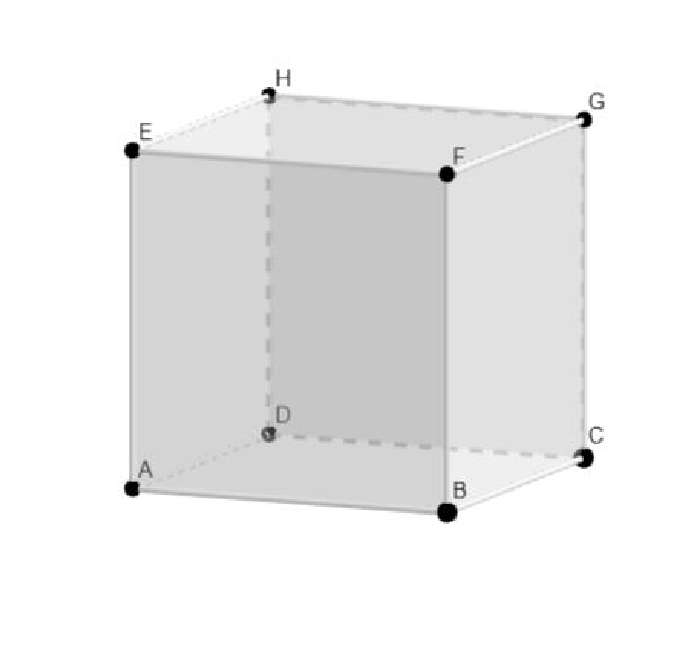
Recall finding a basis for $\mathbb{R}^3$ only requires finding 3 vectors which are linearly independent. Therefore,
(i) Counting $M(3)$ boils down to the number of ways of choosing (in order) 3 linearly independent vertices from this cube.
We will now identify the vertices $A, B, D, E$ with $0, \hat i, \hat j, \hat k$ respectively. There are 7 non-zero vertices, and therefore 7 choices for the first vector. The remaining 6 vertices are valid candidates for the second vector, as they are not a scalar multiple of the first. Hence there are $7 \cdot 6 = 42$ ordered choices for the first two vectors. Hence the third vertex we choose must lie outside the span of the first two.
(ii) There are either 4 or 5 choices for the third vector of the basis.
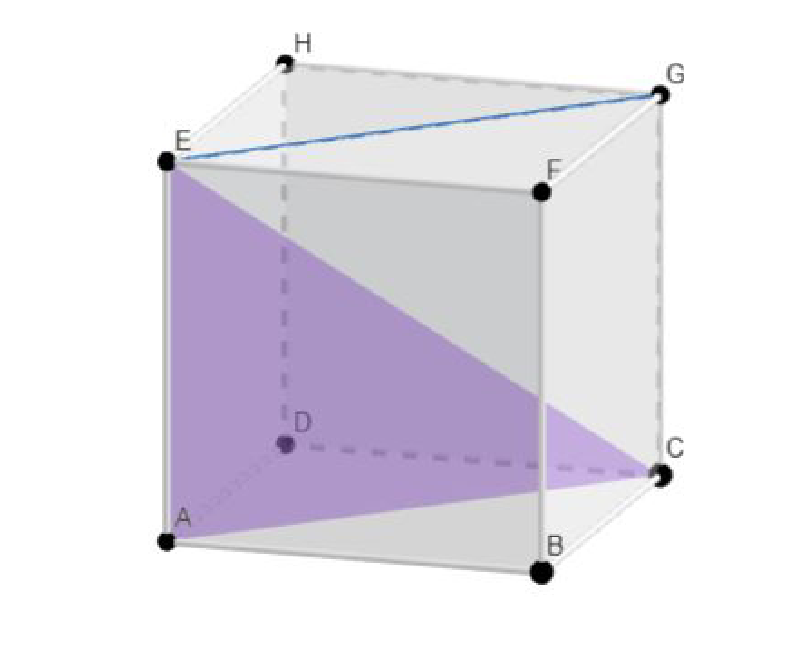
Any choice of two non-zero vertices with the origin $A$ forms a triangular cross-section of the cube. This triangle $T$ can be extended on all sides to span a plane $P$ (subspace) passing through the origin. The intersection $I$ of $P$ and the cube involves at least 3 vertices, namely the three vertices of the triangle $T$. Also from the orientation of a cube it is clear that no plane can contain 5 vertices of a cube. And hence $I$ contains at most 4 vertices. Or, $I$ contains 3 or 4 vertices of the cube, thereby leaving us with a choice of 5 or 4 vertices for the third vector of the basis.
The following is an illustration with $T = AEC$ and $P = AEGC$.
(iii) $I$ containing 4 vertices corresponds to the triangle $T$ containing a side of the cube.
Since the vertices in $I$ and $T$ are vertices of the cube, their sides are either sides or diagonals of the cube. Hence the internal angles of $I$ and $T$ are at most $\pi/2$. But $I$ being a quadrilateral must have its internal angles sum to $2\pi$. Hence clearly, all internal angles of $I$ are $\pi/2$, or $I$ is a rectangle.
But $T$ shares three of its vertices with $I$, and hence shares at least two of its adjacent sides. And therefore $T$ has a right angle. Since the right angles in a cube are formed only between its sides, $T$ has a side of the cube.
(iv) There are exactly 6 choices for which 3 vertices lie in the intersection $I$.
From (ii) we have that in such cases $T$ must contain no side of the cube, and therefore its sides must be the diagonals. But $T$ contains the origin $A$, and hence two of these diagonals must begin at $A$, meaning these two diagonals are exactly the first two chosen vertices. But there are 4 vertices which are diagonally opposite to $A$: three, $C, H, F$, along the faces, and one $G$ through the cube.
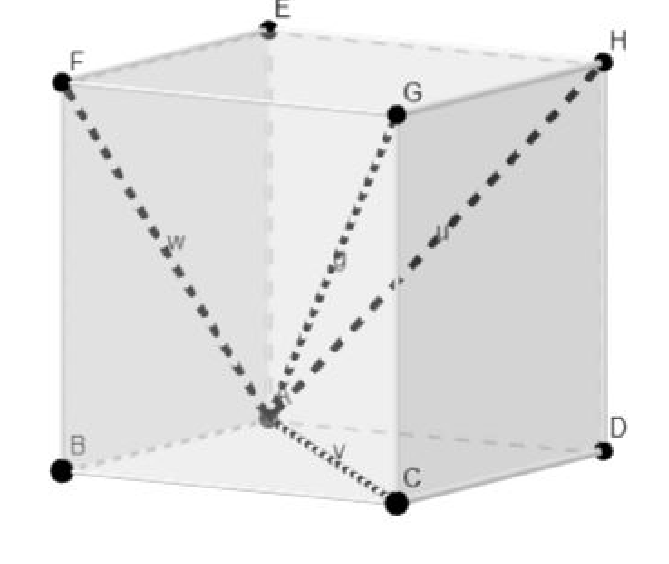
Choosing two of these automatically determines the third side of $T$. But observe that $G$ is connected to the three other vertices via a side of the cube, and hence $AG$ cannot be a side of $T$ from (ii). Moreover, no two other vertices are connected via a side of the cube. Hence $T$ can be determined by choosing any 2 out of the remaining 3 vertices. Since we are also taking the order into account, the required number of choices of $T$ is ${}^3P_2 = 6$.
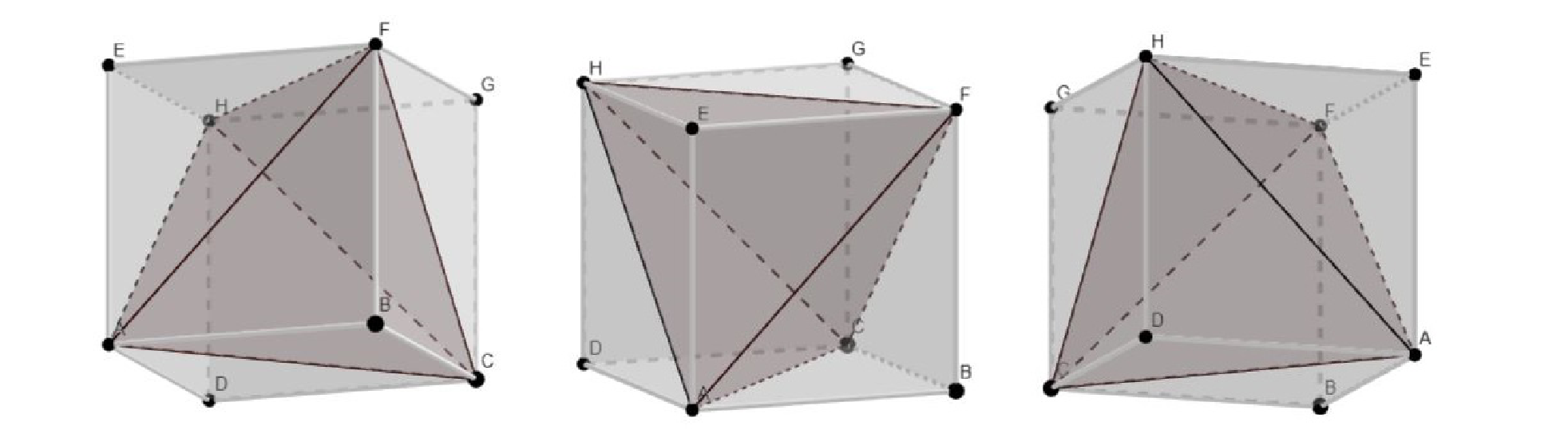
Trivia, these three planes (in these 6 choices) that cut obliquely through the cube to intersect at only 3 vertices form the surfaces of a tetrahedron at the origin.
Finally, from (i) we know that each of the 42 choices of the first two vectors corresponds to leaving 4 or 5 options for the third. But, from (iii) we have exactly 6 of them leaving 5. And hence we have,